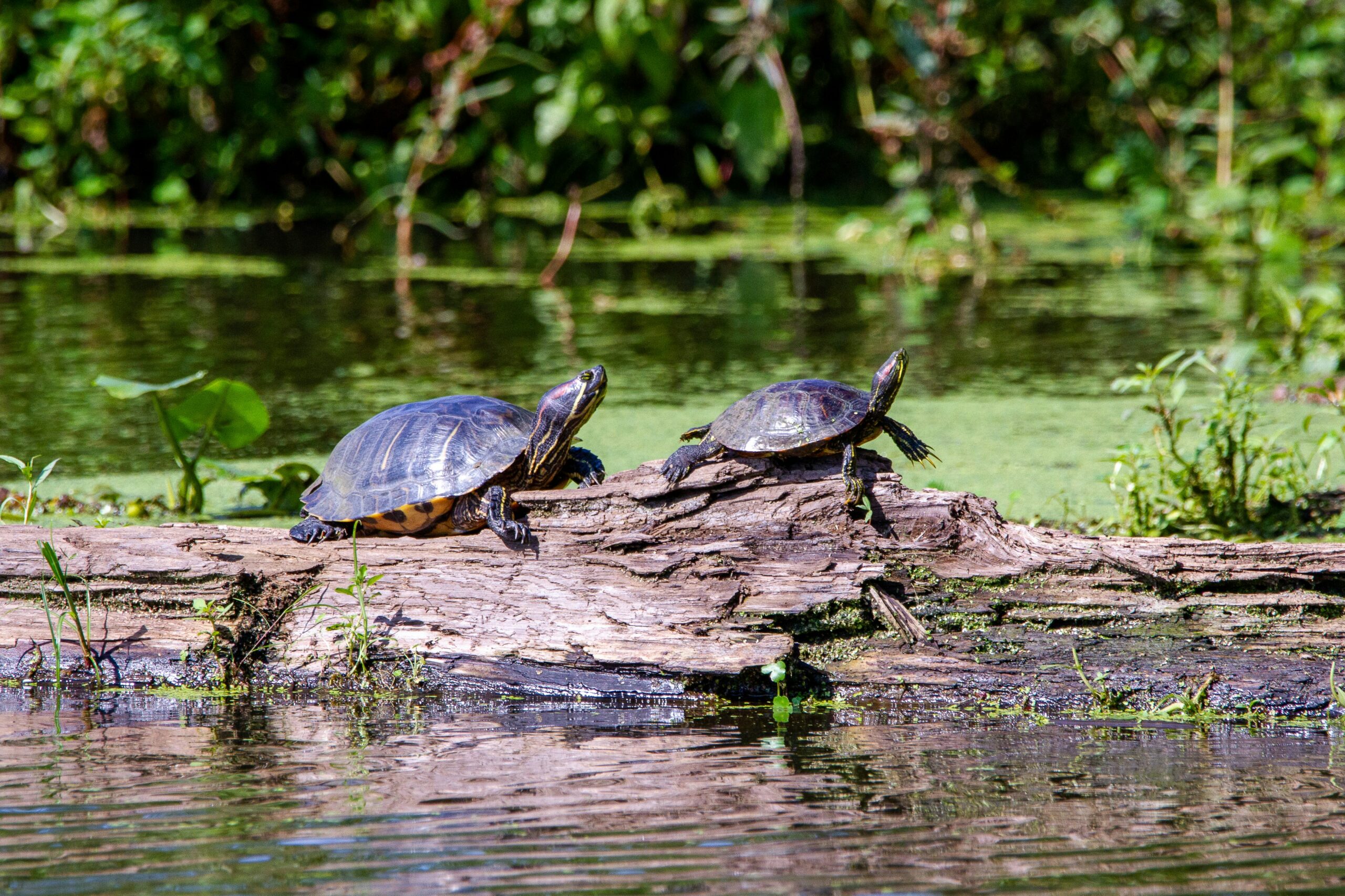
Turtle Pond sits inside Azalea Park, a landscaped green space in downtown Summerville, and it behaves like a small wetland ecosystem. The park sits beside Richardson Stream, so wildlife can move between the stream corridor, nearby drainage channels, and the pond itself.1 Local tourism materials describe Azalea Park as a place with “turtle-filled ponds,” and turtles tend to show up here year-round.2 When people provide extra food, turtle density can climb fast, including into the dozens per acre in fed ponds.3
Animals You’ll Find at Turtle Pond
Turtle Pond’s wildlife includes freshwater turtles, plus the animals most visitors expect around calm, shallow water in town. Visitors regularly mention turtles at the surface and along the banks, along with ducks and small fish described as minnows.4 Travel and history writeups also describe ponds as a recurring feature of Azalea Park, which matches what you notice on a walk across the paths and bridges.21 The Visit Summerville sculpture tour notes “dozens of yellowbellied slider turtles” living near the pond and the “Heron and the Sun” bronze, which helps explain why so many people treat Turtle Pond as a must-stop on a downtown walk.2
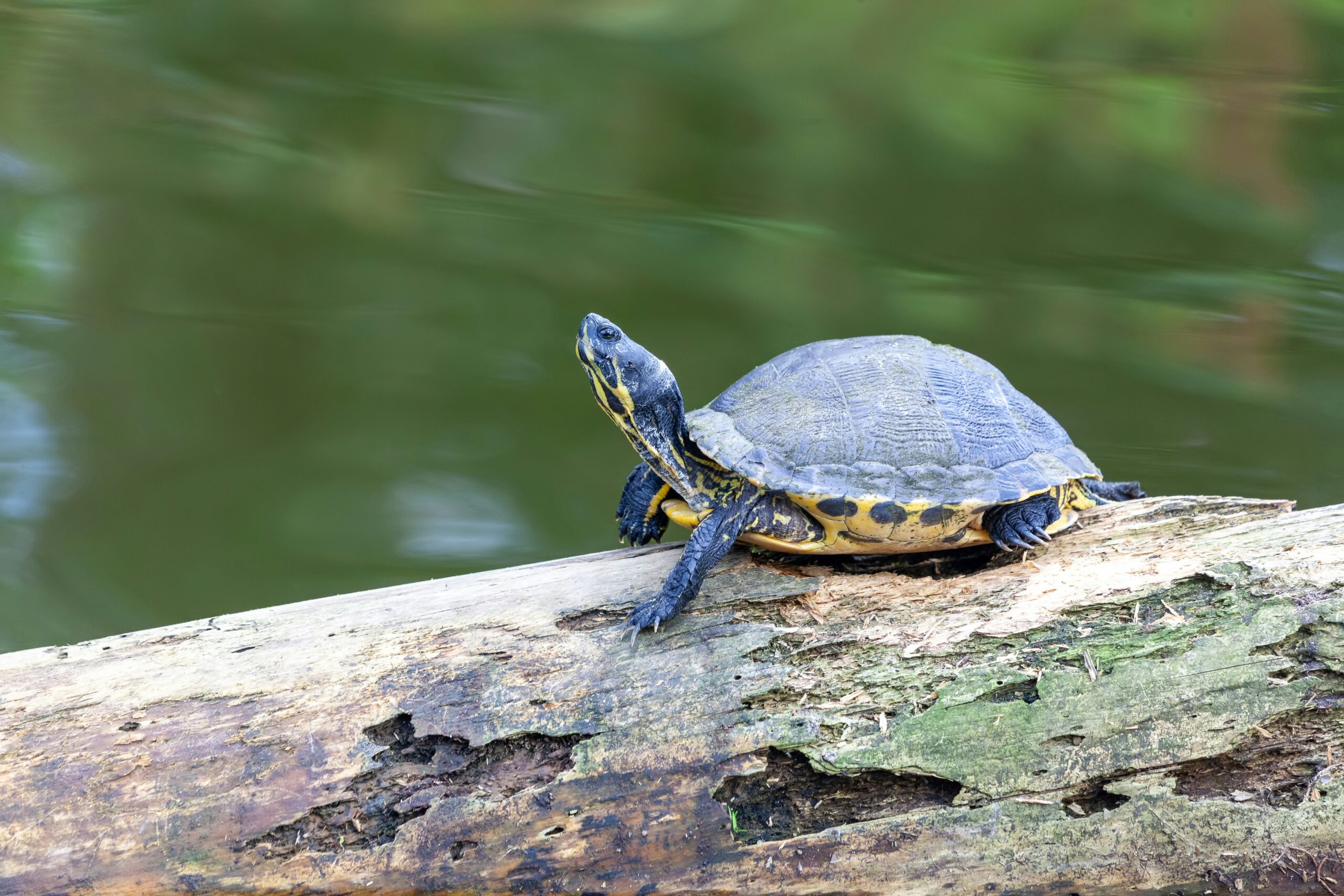
Close-up of a yellow-bellied slider turtle (trachemys scripta scripta) basking on a weathered log above green water.
Yellow-bellied sliders and the other sliders people confuse them with
Yellow-bellied sliders are considered the “classic pond turtle” around Summerville. They bask in groups, slide off logs when someone steps close, and return once things quiet down. A South Carolina reptile reference on pond sliders notes a broad yellow stripe behind the eye for Trachemys scripta scripta, the subspecies many people call the yellow-bellied slider.
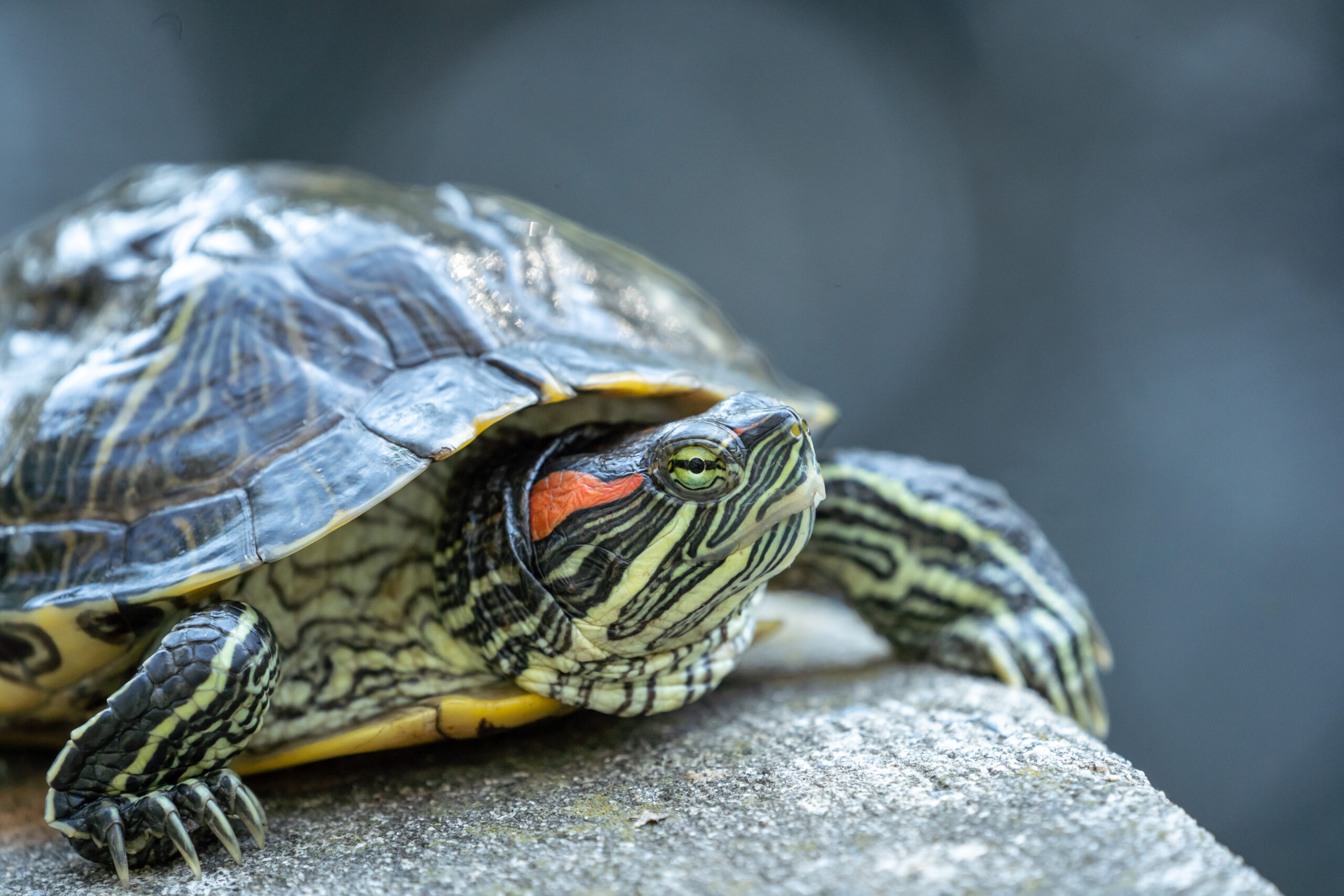
Close-up of red eared slider turtle (trachemys script elegans), sunning himself on a warm fall day.
There’s also a common lookalike in town ponds: the red-eared slider. It has a red patch behind the eye and tends to show up in new places where people release unwanted pet turtles.5
Animals commonly reported right at the pond edge
- Freshwater turtles basking, swimming, and gathering near spots where people pause
- Yellow-bellied sliders, especially near the “Heron and the Sun” sculpture area2
- Ducks moving between the bank and open water
- Small fish described by visitors as “minnows” in the shallows
Climate around Turtle Pond
Summerville’s climate supports long stretches of turtle activity, with warm months running well into fall and winters bringing cold snaps instead of long freezes. That matters at Turtle Pond because a small body of water changes temperature quickly at the surface, yet it can hold a more stable layer near the bottom, especially once turtles settle into mud and leaf litter.
You can also feel the microclimate shift as you move through Azalea Park. Shade from mature trees cools the paths in summer, while sunlit pond edges create warm basking spots. Those two zones sit close together, which helps explain why a short loop around the pond can show more animal activity than you might expect in the middle of town.
How turtles survive cold weather at the bottom of the pond
When water temperatures drop, turtles enter brumation, a low-energy winter state. In pond settings, many turtles settle into the soft bottom and bury into mud where temperatures stay steadier than at the surface.6
They still need oxygen. Some turtles absorb oxygen from the water without surfacing. Specialized blood vessels near the cloaca make it possible, a trick people often summarize as underwater breathing through the “rear end.”6 The U.S. Fish and Wildlife Service also describes winter as a shift into low-oxygen mode for species such as snapping turtles, including the ability to remain submerged for extended periods, sometimes more than 100 days under the right conditions.7
Why Turtle Pond can support a bigger turtle crowd than you might guess
Turtle Pond sits in a park built for walking, photos, and gatherings, and the water works as a focal point. The Town of Summerville describes a gazebo that overlooks the park’s largest reflection pond, which signals how the water feature anchors the experience for visitors.8
In practical ecology terms, a small urban pond can become a strong resource magnet. Extra calories change the math for cold-blooded animals that pace their year around energy. A clear pattern shows up in South Carolina stormwater ponds. Where people feed turtles, numbers can rise far above what the pond’s natural food supply would otherwise support.3 Research in other urban waters points to the same basic mechanism. In a heavily altered urban river system, unusually high turtle density and biomass linked back to human-generated organic waste and other city conditions that increased food availability and survival odds.9
What makes Turtle Pond a unique ecosystem in Summerville
Many towns have a pond in a park. Turtle Pond feels different because it sits inside an ornamental landscape and still acts like a living system with daily inputs and outputs. Richardson Stream runs through the park area, adding a real hydrologic connection in a place many people experience as a garden walk.1
That mix creates an ecosystem with a few defining traits:
Features shaping the pond ecosystem
- High edge-to-water ratio with lots of bank and shallow margins where turtles and ducks spend time
- Human presence almost every day, which concentrates animals near predictable stopping points
- Supplemental food inputs in a setting where people naturally linger, which can support higher turtle numbers over time.3
- A link to a local stream, which makes the pond more than an isolated bowl of water in a lawn.1
What Locals Say
- Erick Delgado
This was beyond fun for our little ones! We went with family to see the pond and the amount of turtles did not disappoint. Our local family came prepared and took small carrot strips that we used to feed and attract the turtles! Great pictures and a definite gem worth visiting.
- jon jackson
Great for a stroll, mostly pine shaded trails wind around azaleas, crepe myrtles and rose bushes past a gazebo and into the open area of the turtle pond. Dozens if not over a hundred red ear and yellow belly sliders call this small pond dotted with cypress islands home. Please be respectful of the park and the wildlife and don't let your kids mess with the turtles.
- Melanie Seay
Always love to feed the turtles and minnows but their water just always looks so bad. Would be nice if there was a fountain there in the pond. We visited today on March 14th, 2024 and the pond look better today than I have seen it look in years.
- Ruben Hurtado
Came here from fishing reviews....were they high when they fished here??? You can catch a ton of branches and fight with the ducks and turtles that eat your bait. Kinda cool pond but very dirty and extremely small.
- Jen Lynn
What a great little experience in a beautiful small park very scenic view with hundreds of turtles poppin' in their lil heads out of the water!! Plenty of benches to sit at a nice gazebo area all around very clean and romantic spot for a nice stroll. I would highly suggest going during a cooler time of the year though, ESPECIALLY Spring to see all of the flowers bloom!!
Turtle Pond is small, but it works like a crossroads. Sun warms the shallows, plants and structure offer cover, and the edges create easy places to feed or rest. That mix pulls wildlife in and keeps it moving, so even a short walk can feel eventful. You leave with the sense that the city is still alive in quiet, ordinary ways.
References
- SCIWAY. (n.d.). Azalea Park. https://sciway3.net/outdoors/park-azalea.html
- Visit Summerville. (n.d.). Walking the Ville Azalea Park sculptures tour. https://www.visitsummerville.com/walking-the-ville-azalea-park-sculptures-tour
- Clemson University Cooperative Extension Service. (n.d.). Managing turtles in stormwater ponds. https://www.clemson.edu/extension/water/stormwater-ponds/problem-solving/nuisance-wildlife/turtles.html
- Chamber of Commerce. (n.d.). Turtle Pond. https://www.chamberofcommerce.com/business-directory/south-carolina/summerville/park/2016917685-turtle-pond
- Zadik, J. (2020, February 20). Pond slider. South Carolina Partners in Amphibian and Reptile Conservation. https://scparc.org/turtles-of-south-carolina/pond-slider/
- National Park Service. (2020, October 4). Beneath the ice. https://www.nps.gov/articles/beneath-the-ice.htm
- U.S. Fish & Wildlife Service. (n.d.). Weathering the cold. https://www.fws.gov/story/weathering-cold
- Town of Summerville. (n.d.). Gazebos at Azalea Park. https://summervillesc.gov/211/Gazebos-at-Azalea-Park
- Souza, F. L., & Abe, A. S. (2000). Feeding ecology, density and biomass of the freshwater turtle, Phrynops geoffroanus, inhabiting a polluted urban river in south-eastern Brazil. Journal of Zoology, 252(4), 437–446. https://doi.org/10.1111/j.1469-7998.2000.tb01226.x